
What does it actually feel like to work here?
Most organisations know what they want the employee experience to be. They want people to feel valued. Trusted.Supported. Included. Able to do their best work.
But organisational intent and employee experience are not necessarily the same thing. The gap between the two is where culture becomes visible. An organisation can say it trusts its people while surrounding them with layers of approval. It can champion wellbeing while allowing workloads to become unsustainable. It can encourage challenge while making disagreement uncomfortable. It can say it values its people while making career progression feel arbitrary or inaccessible.None of these contradictions are usually intentional. But employees experience the reality, not the intention.
So perhaps the more important question for leaders isn't:
“What experience are we trying to create?”
It's:
“What does it actually feel like to work here?”
And what is that experience enabling, or making harder, when it comes to performance?
THE GAP BETWEEN INTENT AND EXPERIENCE
Every organisation has an intended employee experience. It's reflected in employer branding, values, leadership principles, policies and communications. But there is another experience, the one employees encounter every day.
It is shaped by their manager. By how decisions are made, how much control they have over their work, whether priorities are clear. It’s by how easy it is to get things done, whether speaking up feels safe, what happens when they make a mistake, whether good work is recognised, how change is communicated. And by whether leaders do what they say they will do.
This is where the gap can emerge.
The organisation communicates one experience.
The employee lives another.
The larger that gap becomes, the harder it is for leaders to understand what is really happening inside the organisation.
THE EMPLOYEE EXPERIENCE IS BUILT IN THE EVERYDAY
Employee experience can sound like a big strategic concept. In reality, much of it is remarkably ordinary. It's the meeting where nobody feels able to challenge the decision.The approval process that takes three weeks. The manager who always cancels the one-to-one. The system that requires employees to duplicate the same information. The team that is permanently understaffed. The promotion process nobody understands. The leader who says one thing and does another. The colleague who consistently behaves badly but is protected because they deliver strong results. Individually, these moments can seem insignificant. Collectively, they create an experience. And repeated experience shapes behaviour. People learn how the organisation really works. They learn what matters. They learn what is safe. They learn what gets rewarded. They learn where to spend their energy. They learn whether it is worth speaking up.
That's culture in practice.
WHEN GOOD INTENTIONS CREATE BAD EXPERIENCES
One of the challenges for leadership teams is that many poor employee experiences are created by decisions that made perfect sense at the time. A new approval process is introduced to improve governance; a reporting requirement is added to create visibility; a new performance framework is introduced to improve accountability; a restructuring is designed to make the organisation more efficient or, a new system is implemented to standardise processes.
The intention may be completely reasonable. But what happens at the point of delivery? Does the new process make work easier or harder? Does the reporting requirement give leaders useful insight, or simply create more administration?
Does the performance framework create clarity or encourage people to focus narrowly on targets? Does the restructure create greater accountability or uncertainty?
Does the new technology improve productivity or add friction?
Intent is not the same as impact.
This is one of the most important distinctions leaders can make when thinking about employee experience.
THE COST OF A POOR EXPERIENCE
Employee experience isn't simply about whether people are happy. That is too narrow a definition, a poor experience can affect how effectively people work. Consider the cumulative effect of:
• unclear priorities
• unnecessary bureaucracy
• poor communication
• excessive workload
• weak management
• limited autonomy
• lack of recognition
• inconsistent decision making
• low trust
• constant organisational change
Each creates friction and friction consumes something organisations rarely measure directly: employee capacity.
People have a finite amount of time, energy and attention. If too much of it is spent navigating internal problems, managing uncertainty or compensating for poor systems, less is available for the work that creates value.
That doesn't necessarily show up immediately in a performance dashboard.
But over time, it can appear through slower decision-making, lower productivity, increased absence, disengagement, turnover and declining performance.
THE MANAGER EFFECT
If there is one part of the employee experience that deserves particular attention, it is the experience of being managed.Employees may have a great organisation on paper and still have a poor experience because of the environment created by their immediate manager.
Managers influence:
• Clarity
• Feedback
• Recognition
• Autonomy
• Workload
• Psychological safety
• Development
• Trust
Yet managers are often expected to create a positive employee experience without necessarily having the capability, capacity or organisational support to do so. They may be dealing with competing priorities, excessive workloads and pressure from above while simultaneously being expected to support their teams.
This creates an uncomfortable question:
Are we asking managers to create an employee experience that the organisation itself isn't enabling?
If the answer is yes, another leadership programme may not be the solution.
The operating environment may need to change.
WHAT PEOPLE SAY VS WHAT PEOPLE EXPERIENCE
Employee surveys can tell you a great deal. But the most useful insight doesn't necessarily come from the overall score.Look for the disconnects. Perhaps employees say they understand the organisation's strategy but don't understand what it means for their own role. Perhaps they say they trust senior leadership but don't trust their immediate manager. Perhaps they value flexibility but experience increasing pressure to be constantly available or perhaps they believe wellbeing is important but don't feel able to take time away from work. These aren't necessarily contradictions. They are clues.
They tell you that the experience may be more complicated than the headline suggests.
The question isn't just what employees think. It's what their experience is telling you.
DON'T ASK WHETHER EMPLOYEES ARE HAPPY
“Happiness” is an attractive but limited measure. Employees don't need every aspect of work to be enjoyable. They need work to be workable. They need to understand what is expected of them. They need the tools and resources to do it. They need a reasonable degree of autonomy. They need effective leadership. They need to feel able to raise problems. They need to see fairness in how decisions are made. And they need to believe that the effort they put in has purpose. That leads to a much more useful question:
“Have we created the conditions in which people can do good work?”
That is an employee experience question.
But it is also a performance question.
THE EXPERIENCE–PERFORMANCE CONNECTION
There is a tendency to put employee experience and organisational performance into separate conversations. One sits with HR and the other sits with the executive team. But the relationship between them is closer than that.
A useful way to think about it is:
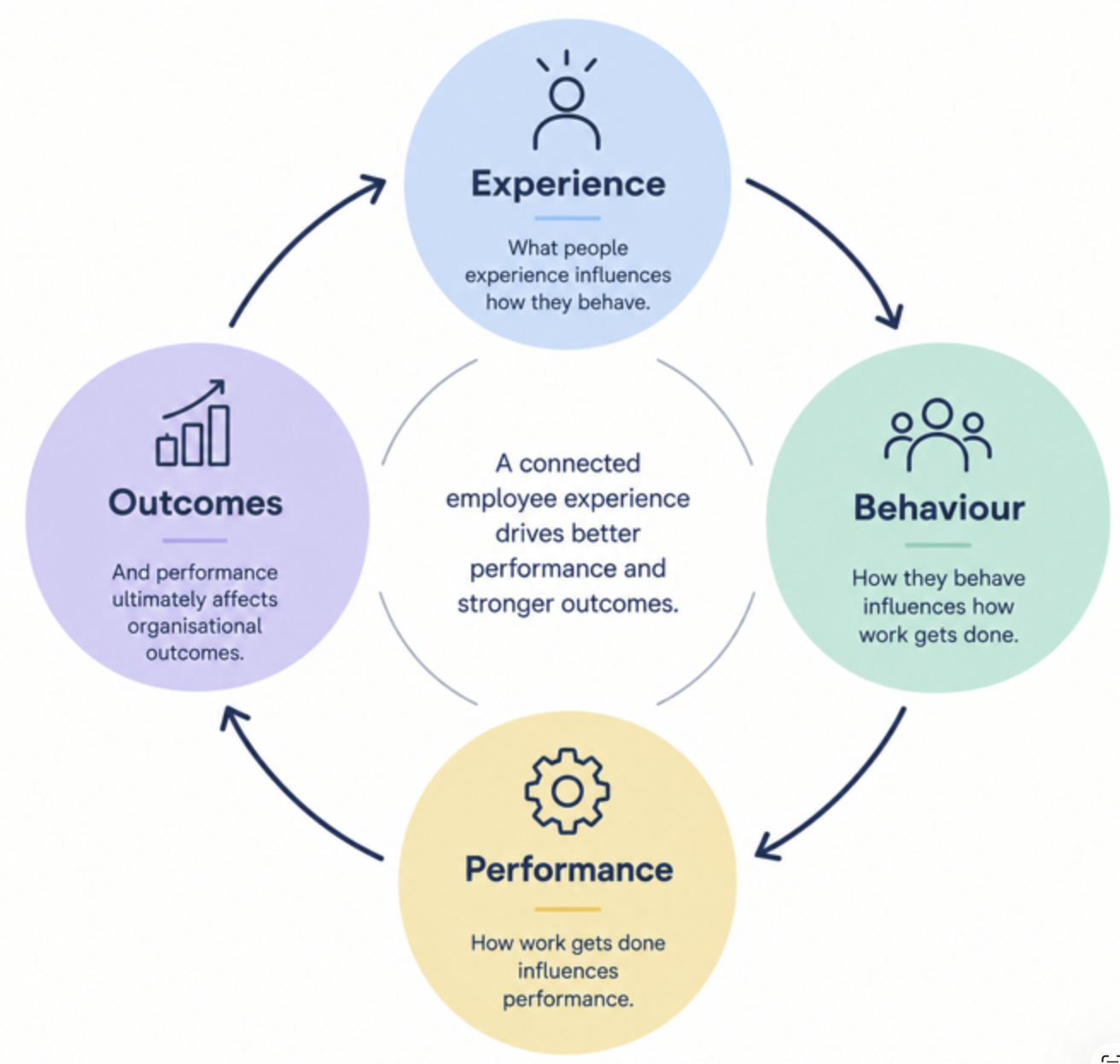
This isn't a simple cause and effect equation. There are many variables involved. But it provides a useful leadership lens.
If employees are experiencing unnecessary friction, low trust or unsustainable pressure, leaders should be interested in what that might mean for performance.
FIND THE GAPS
One of the most valuable exercises leadership teams can undertake is to compare what they believe employees experience with what employees actually report experiencing.
Ask your leaders: Do our people feel trusted? Do our people have the tools and resources they need? Can people challenge decisions?
Then ask employees.
Ask leaders: Do our people have the tools and resources they need?
Then ask employees.
Ask leaders: Can people challenge decisions?
Then ask employees.
Ask leaders: Do managers have the capacity to lead effectively?
Then look at the employee experience within those teams.
The gaps are often more revealing than either answer on its own. Because the gap tells you where organisational perception and employee reality diverge.
LOOK BEYOND THE ORGANISATION-WIDE SCORE
As with culture, averages can conceal the experience that matters most. An organisation might have a strong overall employee experience score.
But what happens when you look underneath it?
• By team
• By manager
• By location
• By role
• By tenure
• By function
• By level of seniority
Patterns can emerge.
Some teams may consistently have stronger experiences. Others may have higher levels of absence, lower engagement or greater turnover.
The question isn't necessarily “What's wrong with that team?”
It might be:
“What is different about the environment in which that team is operating?”
That is a much more productive starting point.
FROM LISTENING TO ACTING
There is another danger in employee experience. Organisations can become very good at listening.
• Surveys
• Focus groups
• Town halls
• Feedback platforms
But if employees repeatedly tell you about the same problem and nothing changes, listening can become counterproductive.It teaches people that speaking up doesn't make a difference. The objective should not simply be to collect more feedback. It should be to understand what the feedback is telling you and decide what needs to happen as a result.
Sometimes the answer will be to act. Sometimes it will be to explain why something cannot change.
Both are better than silence.
Listening creates value when it changes understanding, decisions or behaviour.
THE LEADERSHIP QUESTION
The employee experience is ultimately a leadership responsibility. Not because leaders control every interaction. They don't.But leaders create many of the conditions within which those interactions happen. They determine priorities. They design structures. They establish incentives. They allocate resources. They choose what to measure. They decide what gets challenged. They decide what gets rewarded.
And they set the tone for how the organisation responds when things go wrong.
So the question isn't:
“Are our employees having a good experience?”
It is:
“What experience are our leadership decisions creating?”
That question is harder. But it puts responsibility where it belongs.
THE PULSE POINT PERSPECTIVE
Employee experience is not a standalone measure of organisational health. It is a source of intelligence. When viewed alongside workforce data and organisational performance, it can help leaders understand where friction is emerging, where experiences differ and where the organisation may be creating unintended consequences.
The goal isn't to create an organisation where every employee has a perfect experience. That isn't realistic.
The goal is to understand whether the experience people are having is helping them do their best work and whether the organisation is creating the conditions for sustainable performance. Because there will always be a gap between intention and reality.
The leadership challenge is knowing how large that gap is, where it exists and what it is costing you.
ONE FINAL QUESTION
Imagine you joined your organisation tomorrow. You know nothing about the strategy. You haven't read the values. You haven't seen the employer brand. You simply experience the organisation through its systems, managers, meetings, decisions and behaviours.
What would you conclude this organisation really values?
And perhaps the more important question:
Would that experience make you want to do your best work here?





.png)